Showing posts with label Squatting. Show all posts

Sunday, 16 November 2008

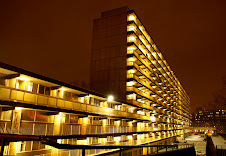
KingsHill II

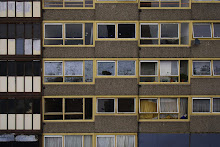
Back on Kingshill . . . once you seen it, you don't want to leave. 

Saw two families pulling stuff into the lift and out again into a van parked at the bottom. Looked Asian. One black couple. Everyone friendly, easygoing. Maybe leaving brings it out. 

Drizzle, the fog enveloping the Gherkin, the dome of St. Paul's, the towers of the city. Tower Bridge off in the distance behind the blunt edge of another tower. The drizzle made the foilage between the buildings seem more febrile, alive - you could smell the moss, the green and for seconds at a time, I felt like I was back in my native British Columbia, walking through the woods, with the damp dripping from the trees onto the rich undergrowth. 

Memories. Squatting in London, tearing away iron doors from blocked up flats like the ones on KingsHill to get inside some shabby council flat. I never squatted in towers like the Heygate, but I roamed them often enough, wondering what I was doing in London wandering these shabby estates looking for a place to live. Every spring I'd go back to British Columbia and work in the forests for two or three months to make enough money to live for the rest of the year so I guess those two images - council flats blocked up with iron doors and rain dripping down through the rainforest canopy are linked inextricably - bizarrely - in my mind. 
   
What will the credit crunch bring to the Heygate? Already there is talk that the private developers responsible for the demolition and 'restoration' of the estate and environs, might not be able to access the funds to come through. The government is guaranteeing high-profile projects like the Olympics and Crossrail - but will they come through for the Heygate? 

What happens then if nothing is done at all. The Heygate comprises some 1260 units - will they just remain empty? Let's say the council moves everyone out yet the demolition doesn't take place, the estate just sits there, rotting. Inevitably, with more and more pressure on the rental market - people who now can't afford to buy or have lost their homes have to live somewhere - there will be pressure to make those 1260 units available again. By that point, many of these flats will have been vacant a year or more, their already delapidated condition that much further gone - will the council even be able to move tennants in? 

At what point do the squatters take over? 

Friday, 11 January 2008

Crossroads


Had to go to work in Mayfair yesterday. Left the Elephant at five am for a six am start. No tubes, a twenty minute wait for the bus in the cold London dark. The busses were packed. Not quite standing room only, but close. All Latins or Africans, on their way to cleaning jobs in Victoria, Mayfair, Belgravia. These people make up a significant proportion of the Elephant’s population now . . .
The afternoon before, I watched as four men (maybe one was a woman) roamed up and down the terraces of the big estate on Heygate Road. Dark-haired, dark-skinned – Latinos probably. One guy leaning over the balcony keeping watch, the others checking behind the metal grating covering the windows, looking for a way in. Edging up and down those long terraces as if like figures in a video arcade, visible to everyone on the estate.
They left, hurrying down the stairs and back into the street, so I gues they didn’t find anything.

The Latin thing here was totally unexpected. When I first walked into the Charlie Chaplin pub in the mall, I thought for a minute I was back in the States because of all the short, Mexican-looking guys hanging around the pool table talking Spanish. On the upper level of the mall are two Colombian cafes and a Colombian (??) restaurant serving great empanadas and Spanish coffee. I wonder why they chose the Elephant of all places?

I mentioned the four would-be squatters I’d seen to my flatmate. “Squatting’s coming back now,” he said. “The migrant population is saturated – all the jobs are taken, all the places to live are full. So these people roam the estates looking for a place to put a roof over their heads.”
He said squatting really took off in England after WWII. “All the soldiers came back from the war and found the government didn’t give a toss about them. They saw all these empty properties, they needed a roof over their heads, so they took what they could get . . .”
The Walworth triangle, from the Elephant down to Burgess Park and I guess to the bottom of the Old Kent Road, is the most densely populated area in Europe. “Think about it – it’s nothing but estates. Everyone wants to improve it, but where are you going to put all these people?
“So many people who come to London from somewhere else – it could be Europe or South America or the North somewhere – and are basically skint – end up in these estates in south London – especially the Elephant. Where else can you go? This is the starting point for so many people who come to London. Everything comes through here – the Old Kent is the A2, which runs from Dover to London – that’s why you have all these coaches coming through reading ‘Polski’ or whatever. And everyone here has a story to tell.”

It’s true: the Elephant, especially now when so much of it is to be torn down and rebuilt, feels like a clearing house, a way station between one point and another. Living on this estate feels, quite literally, like living on a platform looking out on the rest of London. Even late at night it buzzes with motion as traffic hums through the four or five major arteries that feed from the south into the roundabout – a constant hum of decelerating diesel engines, clattering trains, car horns, incoming jets, the general whoosh of traffic.
Yet, in the fall at least, in-between the traffic you can hear the rustle of the leaves across the concrete, the whispering of the wind through the tree branches.

From here you can walk to Waterloo, Wesminster, the Tate Modern – right over the Millenium Bridge and into the City – and all in less than an hour. By train it is fifteen, twenty minutes. You really are on the edge of the city centre.