Wednesday, 30 July 2008

Filming On the Heygate - PtI


Stairwell, Villa Savoye

An old friend from Canada showed up last week. He is making a film about modernist architecture. He has already filmed in Montreal, Hong Kong, Brasilia, at that palace to Modernism, Le Couboisier's Villa Savoye in Pouissy, France, so of course I had to take him to the Heygate.

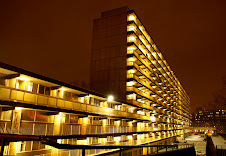
   We hit Claydon House, my old building, in the full glow of the early evening light - one of those radiant summer evenings that remind me of the summer light where I grew up in Northern Canada. As we wandered up and down the terraces, I was amazed at how many flats had been blocked off - half the terrace on some levels - and how empty the estate felt. When a gang of kids appeared at the top of the 11th floor, running from the stairwells to the lifts, they seemed like a mirage. 

  
   On the edge of the 11th floor, we leaned against the fencing and talked about gentrification. Out behind us were the lead towers of the Aylesbury Estate, their upper terraces suspended above the greened-up trees and lines of rowhouses so they did indeed look like 'cities in the sky'. Brahm said that in Paris, where he lives now, the central part of the city is almost like a gated community. "The cops make sure no one from the bainliue can come in and raise shit, and whole sections have become playgrounds for the offspring of the rich." 
   This is true of all great cities now - Paris, London, New York - and once places like the Heygate disappear, the non-rich will disappear with them. since it was the non-rich who gave these cities their character, where will the great cities be in ten, twenty years time? 

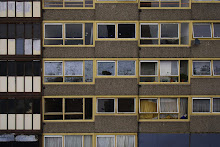
   We wandered through the gangways, marveling at the sheer scale of the building, the colossal delusion of the architects who built them. Brahm talked about how the modernist project became so central to post-war planning that no one dared oppose it, that then, as now, developers made big money colluding with governments to bring us places like the Heygate. That even when people pointed out the inhuman scale of these places, their objections were shrugged off - concrete blocks were the future and 'that's just the way it has to be'. I noticed how many windows were smashed or hung open, exposing the empty flats inside, how deserted the walkways were at an hour when, even in winter, they would have been almost full. But for some kids on the playground, the whole estate seemed to contain barely anyone at all . . . 


Tuesday, 29 July 2008

Endgame Continues

The Big Estate on Heygate Road. Probably two thirds empty now. Look for the lines of grey iron plates over the doors and windows. 

Tuesday, 15 July 2008

Stag-Hunting on the Heygate


. . . .and in the vacant lot in front of Claydon House, someone has built a STAG out of scaffolding bars. 

   Nascent scaffolding was in place before I left, in the middle of the empty lot where the car park used to be -  as if they were finally going to start building something there - and when I first saw the stage, gleaming in the shadows behind the Elephant and Castle train station, I wondered if some builders got bored waiting to go to work and said, "hey, let's build a stag!" 

   But no, it's an artist. It's always an artist. Guy named Ben Long. You can read about him here


Heygate in July

Back in the Elephant and Castle Train Station after three, four months away . . . 

    They've painted the handrails a glossy dark pink the same colour they painted the mall back in the early 90's in the dark days of the last recession. Harbinger of things to come? 

    Bright new windmill which looks like a serrated barrel, spinning deliriously next to the old windmill, powering all of three or four flats I'm sure. 
   
   A| drunk screams abuse at no one in particular somewhere down the platform. A new hi-rise is going up up next to the tracks. 

   Claydon House as grim as ever, with a few more of those Death Star iron patches over the windows. Latin kids playfight in the stairwell, taking jabs at each other and edging up and down the stairs. Even with the greened up trees, the estate looks about as inviting as a keelhauled battleship.  As ever, Massive Attack goes well with the scene from No. 4 train platform, like a sound track to grey sky, the concrete gangways and the iron plates over the windows. 

   And so, London marches steadily on to 2012. Who will in the city after the Olympics have come and gone, I wonder? For those of you who are interested, I'd show you pictures if I hadn't left my freakin' camera in Toronto. Had to borrow these off the web.  

Sunday, 1 June 2008

Vintage Photographs from the Elephant

Vintage Photographs of the Elephant from the James Hyman Gallery: 


Monday, 5 May 2008

Siouxsie Sioux and the Aylesbury

Caught the 343 down to Brockley today. A relatively painless ride except for some African yelling into his mobile right down to Peckham Rye. Even after I put the headphones on, I could hear this guy yabbering away, his outburst resounding in staccato points between the lows and highs of the music. Finally, it was just him and me on the top level, and even with the music cranked, I could STILL hear the silly fucker. 

   What the fuck is it with people here and their mobiles? The mobile phone has ruined so many public spaces in London. 

   On the way back, the peaks of the Aylesbury appeared just as Siouxsie and the Banshees 'Quartermaster of the Dog' came on the headphones. That slow guitar opening, seguing into the repeated riff then Siouxsie's childlike (or just plain childish) organ riff - moody, haunting, one of the songs that made up the soundtrack to my younger days haunting marveling at places like the Aylesbury. With the sunlight reflecting off the rows of windows, the towers - two or three city blocks long, angled north-south and stacked one behind the other and joined by lines of two or three story buildings with the same grey stucco panels and factory issue council windows, the same little balconies and yards, interspersed now with satellite dishes . . . old white couples tapping forward on their canes, middle-class looking black people in nice hats and coats. A 'KIDZ' centre and the text of the 'I have a dream' speech by Martin Luther King painted as a mural on the wall. 

   Then came the lead edges of one of the towers, spreading out along the horizon like some sort of freighter  - a freighter converted into a refugee ship, arriving with the dawn. 

   These shapes seem so iconic now. Channel 4 recognized as much when they started using Mark Lewis' clips of the Aylesbury as one of their intro sequences. But for me,  it will always be a symbol of the period in my life when I was fascinated by these huge estates and how they sprawled over south London. 
   

Sunday, 4 May 2008

Dawn

Woke up this morning to the dawn breaking over that huge estate behind Heygate Road, the one that rises like a cliff from the mass of tree branches down below. Even in the shadow cast by the rising sun, you can make out the metal plates over the windows, the bare concrete and metal where the paint is peeling away. From a distance, the estate looks like some drydocked tanker being readied to be keelhauled. That same melancholy feeling of a long journey coming to an end, the structure breaking apart under it's own weight. 

I'd almost stopped noticing that estate - indeed become sort of inured to it. Remarkable how quickly this can happen - the flacking concrete, the iron bars, the massive buildings themselves - all become background. Last night, when the kids were out in the little playground out back of Claydon House, swinging on the miniature ferris wheel, and people strolled along the walkways coming home from work, you could almost forget about the estate altogether. You stop seeing the estate but it's empty spaces, it's decay, it's inhuman scale, all become a part of you and you stop seeing outward. A part of you starts going numb and the estate begins to claim you.