Found this on Youtube this morning:
Valentines Day Ball at the Heygate
Mostly old folks gathered in a community hall - I"m guessing the hall behind what used to be the doctor's office, now the office for the Heygate Tennant's Association. Probably the last time people got together like this on the estate.
It says a lot that in the six or seven months I lived on the Heygate, I was hardly aware that this older, white working class still existed. The faces I saw were mainly those of immigrants - Africans, South Americans, East Euros. This, I"m sure, had a lot to do with the fact I was an immigrant myself, albeit of a different kind. But it does say a lot about the alienating power of the estate, when you can't even get a sense of the people who live around you.
Where are these folks now, I wonder?
Saturday, 24 October 2009


Friday, 23 October 2009
Call in Guardian for more council housing . . .

The new elephant. The Strata tower, looking down the tracks to Walworth Road.
High Time for More Council Housing:
Columnist Patrick Collinson bikes by the Hegate Estate every morning. Apparently, the Heygate is 'the best known and least loved' housing estate in Britain. I would have thought the much worse Aylesbury or the since-demolished North Peckham Estate (never mind a few choice estates in Liverpool, Salford, Edinburgh . . . . the list goes on) would qualify. But never mind.
He makes the very valid point that the architectural mistakes of the 50's and 60's have colored Britain's view of council housing, leading to a housing shortage. I certainly experienced this in London - the quality of housing for the non-rich was appallingly bad - which is partly why I moved onto the Heygate.
Of the new housing across the roundabout, he writes:
A grim walkway under a busy roundabout connects the Heygate to the first major new residential development in Elephant & Castle, built on the site of a demolished council block, Castle House. But the evicted residents of the Heygate can only look up in awe. You can find a selection of one-, two- and three-bedroom flats in the 43-storey Strata Tower, now nearing completion. But housing benefit won't quite stretch that far. Upmarket estate agents Savills is marketing a one-bed flat in the new block for £850,000. A three-bedder is in the millions.What struck me most about all the talk of 'regeneration' when I lived in the Elephant, was how little attention was being paid to the neighborhood that would result. It seemed pretty much a given that this nice new Elephant, with it's tram lines and boulevards lined with cafes, would no longer be working class. Sure, they'd put in a few low rent flats, but after how many years of development, what community had existed on the estate would be broken up and very unlikely to come together again. Certainly the posters put up around the Oakmayne site ('Believe in Oakmayne!'), showed nice white very middle class people on those boulevards or sitting in the terraces of their nice little flats.
The Elephant has always been a working class neighborhood. When I first moved there in the 80's, it was Irish working class (or at least my section of it, on the Rockinham Estate, was Irish), in my most recent experience, it was populated primarily by immigrants. Either way, it was inhabited mainly by poor people, and that was it's identity and it's (sort of) charm. T|he Heygate, by dint of it's ugliness, was a kind of rampart against the ocean of gentrfication pouring in across the tracks. Take it away, and the Elephant will be just another boring Zone 1 neighborhood.
I mean what kind of moron pays 850,000 pounds for a one bedroom flat? Anywhere? And next to one of the world's biggest construction sites at that. Will these people be going down to the East Street Market, I wonder?

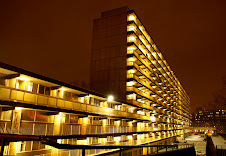
View looking south from Ashedon House.
Thursday, 15 October 2009
Latest Developments
 From London SE1:
Lend Lease "still very interested" says chief executive, Dan Labbad.
"We believe that we're close to the bottom of the market in the UK . . . It's the right time to invest in regeneration schemes which is why we are very interested in our position at Greenwich, our discussions at Elephant & Castle and also being involved in Stratford for the medium to long term,"
Despite this, Mr. Labbad said 'significant barriers' still existed for 'entry' including the credit market, and a suitable partnership with the government.
Meawhile . . . The two Caryatids sequestered in the little garden in the middle of the estate, have been moved out. The two caryatids (a column carved in the shape of a person, in this case an imitation of the stone lady statues on the Parthenon) were carved by Henry Poole in 1885 and decorated Rotherhithe Town Hall, until bombing destroyed the Town Hall building in 1945. The caryatids survived however, and were installed on the Heygate.
I discovered the two stone ladies last year, but had no idea of their history. They seemed totally incongruous in the conext of the estate, but they were a nice touch nonetheless. If you looked into the little garden from the right angle, the green blocked the towers on either side, and you could imagine you were somewhere else entirely.
Also, from the Independent: London: City of Broken Dreams: reports that East Euros made desperate by the recession are squatting the Heygate. The council claims that there are no squatters on the estate (of course). But if the deal with Lend Lease is NOT signed, I wonder if the whole estate will be taken over? Who would stop them?

Friday, 9 October 2009
Regeneration Skyscraper Plans Under Threat

From London SE1:
Boris Hyde Park Policy Change Could scupper SE1 skyscraper plans
From the article:
"In June Boris Johnson published draft planning guidance to protect significant views of London landmarks.Among the new measures proposed in the document is an additional protected view from the bridge over the Serpentine in Hyde Park towards the Houses of Parliament and Westminster Abbey.
On Tuesday night Southwark's planning committee was told that this new protection could affect proposals for tall buildings as part of the regeneration of Elephant & Castle.
The council's head of design & conservation Michael Tsoukaris told councillors that the effect of the policy would be to cap the height of future developments at some locations around the Elephant & Castle northern roundabout at 65 metres."
Among the buildings affected would be Oakmayne Plaza, the hi-rise complex along New Kent Road which would replace the Heygate. Oakmayne, as it is proposed now, would be 87.5 metres.
Thursday, 17 September 2009
But of course . ..
From the South London news . . .
Should pink elephant be Southwark's Olympic Icon?
Maybe they should have a model of the whole shopping centre. Or the Heygate.
Should pink elephant be Southwark's Olympic Icon?
Southwark residents have been invited to choose whether their borough should be represented by the Elephant & Castle or Shakespeare's Globe in a set of souvenir pin badges to be produced for the London 2012 Olympics.
Maybe they should have a model of the whole shopping centre. Or the Heygate.
Tuesday, 15 September 2009
Deja Vu All Over Again.

From the Guardian:
It sounds like a fairy tale - until you get there. But now a magic wand is poised over the Elephant and Castle.
From the article:
'This is the week that the London Borough of Southwark sets about asking local people and businesses what they'd like to be done about one of the city's oldest shopping centres. The Borough has a pretty shrewd idea of what to do, but is asking all the same.
'The Borough. . . spurred on by . . . it's intelligent and indefatigable Director of Regeneration and Enviroment . . . plans to transform the Elephant into a "new landmark of urban and environmentally-friendly design: a development that could be seen as exemplary, worldwide."
'The emphasis here is on public transport and the linking together of many railway stations and bus stops that serve the area. They may also include working with approved firms of architects - not just developers' puppets, but those who will raise the standard of architecture here to the highest global standards. This includes new housing and the renovation of existing stock.
'The borough insists that it is not trying to turn the Elephant into a new middle-class ghetto or just another shiny downtown development . . . in raising it's cultural sights, however, Southwark must be careful not to undermine it's indigenous population . . . It is, at heart, a working-class quarter of London, made up of many creeds and colours. What it needs to do is find ways of engineering in the hearts of those who live and work here a sense of belonging to a new world in which they all stand to benefit if and when the Elephant comes into it's own.'
Sounds great doesn't it? The problem? The article is dated, '15 March, 1999'.
I hadn't realized it until I read this article - I was away from England for over 12 years until I went back in late 2007 - but the regeneration process has been in place for a decade. The original company pulled out not long after this article was written and the plan languished ever after.
Today, from LondonSE1: Elephant and Castle regeneration: Southwark Council leader 'cautiously optimistic' that a deal can be reached with Lend-Lease by the end of 2009. From the article:
"I am cautiously optimistic about the chances of reaching a development agreement with Lend Lease by the end of the year," Cllr Nick Stanton told members of the cross-party Overview and Scrutiny Committee at the town hall on Monday night.
"I've said before that if Lend Lease were going to walk away from this they would have walked away by now. They clearly have walked away from a number of propositions where they felt that the numbers weren't stacking up for them."
"They are still very interested in the Elephant & Castle. They are talking with us and we have been doing some financial modelling work with them. I'm told that that's gone very well."
If a deal isn't signed, what happens then? Does the estate just sit there year after year, falling into total disrepair? Or will the council demolish it, no matter what the cost, just to get rid of it? What then? A vacant lot that sits on the site for years afterwards, taking up valuable land?
Monday, 14 September 2009
Painting Moths on the Heygate
Big Brush of the 'Paint the Heygate' project gives a moving description of walking around the nearly empty estate. On the massive Kingshill Building (she calls it the Aylesbury here, but I think she means Kingshill), they find a council worker who shows them round. They find exactly one person left on the whole building, out having a cigarette on the empty terrace. "No comment" he says, as soon as he sees them, obviously marking them for press.
Subscribe to:
Comments (Atom)


 Posts
Posts


